

Something Sweet: Tapping the Pacific Northwest’s Bigleaf Maple for Syrup
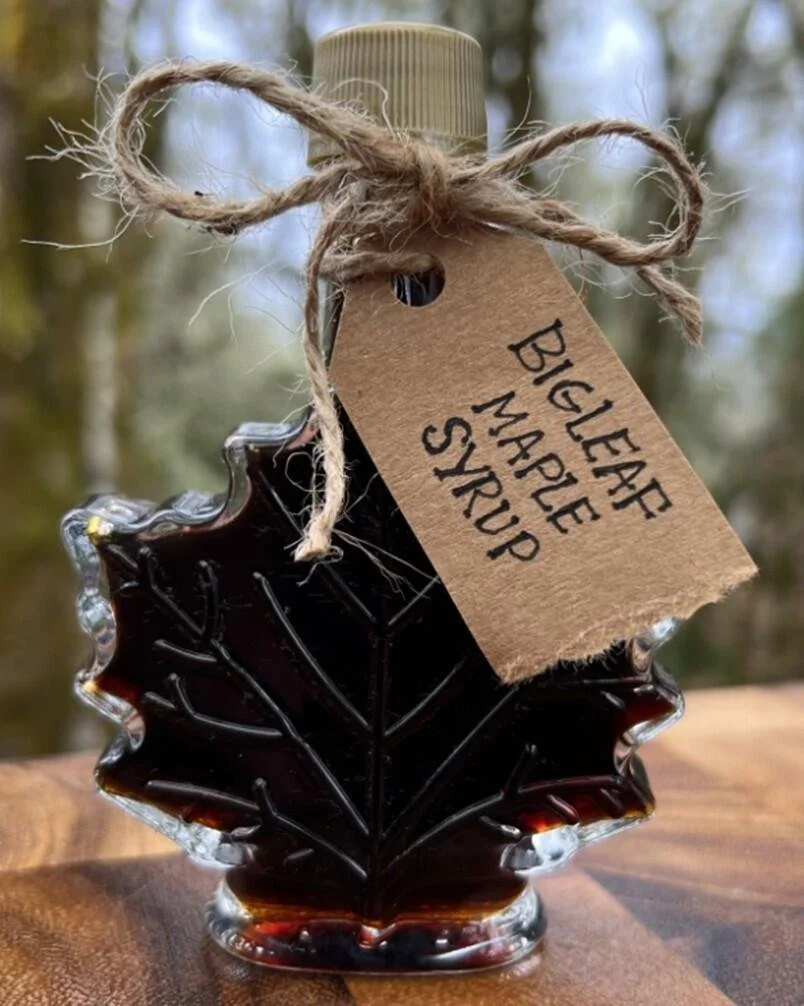
Photo by Melanie Douville
Written by Sarah Cameron, Oregon Women Owning Woodlands Network Coordinator, Oregon State University
When you imagine the taste of maple syrup smothering your pancakes, it’s likely the sugar maple (Acer saccharum) that comes to mind, native to the midwestern and northeastern United States and eastern Canada. All maple species share a notable characteristic, during oscillations of below- and above-freezing temperatures, pressure gradients move sap from the roots to the crown of the tree and back again. On the journey downward, if a hole is drilled into the tree, a lightly sweet sap will escape. This is the sap that, when boiled down, becomes the thick, sweet syrup so many of us love.
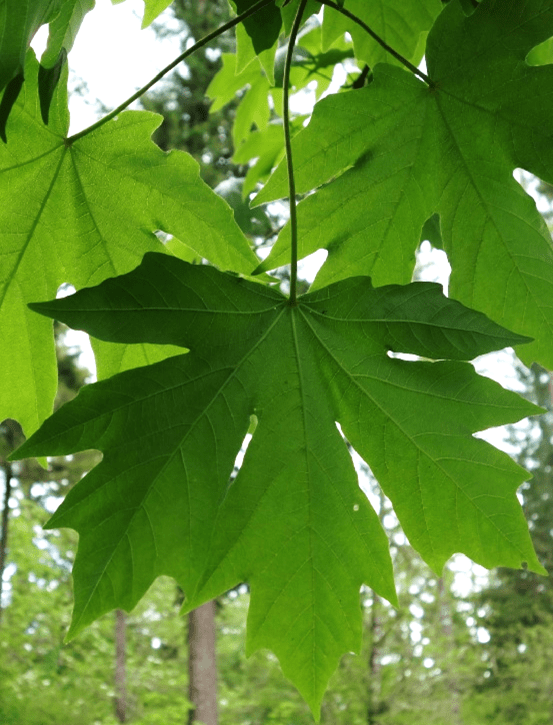
Looking from east to west in the United States, the maple landscape shifts from a mosaic of red, sugar, and silver maples to the dominant maple of the Pacific Northwest, the bigleaf maple (Acer macrophyllum). While the bigleaf maple gets its name and recognition for its large leaves, spanning nearly 12 inches across, it is catching attention for another characteristic – the emerging field of bigleaf maple syrup. Although bigleaf maple sap contains roughly half the sugar content of sugar maple sap, its syrup offers a unique and rich flavor profile that is quickly earning a devoted following.
A Brief History of Bigleaf Maple Sugaring
While it isn’t clear exactly when people began tapping bigleaf maples to make syrup, the first mention arose in 1952 when the Oregon Journal featured a story on Reinhold Bieberdorf tapping his bigleaf maple trees (Jones, 2025). This is a far cry from the sugar maple, whose tales of syrup making date back to at least the 1700s, passed down through generations of Indigenous knowledge and storytelling.
Although bigleaf maple syrup production doesn’t share the long-documented history of sugar maple sugaring, the tree itself has long held significance for many Indigenous communities of the Pacific Northwest. Its bark was used to thicken soups, make ropes and baskets, and treat illnesses such as tuberculosis. The large leaves served for food storage, flavoring, covering cooking pits, and providing a clean surface for preparing fish. The wood was also highly valued, crafted into utensils, bowls, canoe paddles, and other essential tools (Bowyer, 2024).
Current day, interest in bigleaf maple sugaring is accelerating. Estimates suggest that hundreds of hobbyists are tapping bigleaf maples across the Pacific Northwest, with dozens more venturing into commercial production (Price et al., 2024).
West Coast Versus East Coast Sugaring
So, what is the difference between making maple syrup from Midwest and Northeast maples versus the Pacific Northwest bigleaf Maple? There are a few key distinctions outlined by Matzka et al. (2025).
Sugar maple sap typically averages 1.25 to 2.5 Brix (1 Brix = 1% sugar in solution), while bigleaf maple sap averages 1.0 to 1.5 Brix. Sugar content determines how much sap is needed to make syrup: roughly 80 gallons of 1.0 Brix sap are required to make one gallon of syrup, compared to about 40 gallons of 2.0 Brix sap.
Historically, this lower sugar content made bigleaf maple syrup labor-intensive. But modern tools, especially small-scale reverse osmosis (RO) systems, are changing the equation. These systems remove a portion of the water before boiling, dramatically reducing time, fuel, and cost. Paired with emerging research and community guidance, technology is making bigleaf maple sugaring more accessible than ever.
Climate changes the playing field as well. Unlike the crisp, predictable freeze–thaw cycles of the Northeast and Midwest, the Pacific Northwest’s maritime climate produces a far more erratic sugaring season. Tappers must be ready to act quickly when a stretch of above-freezing days paired with below-freezing nights appears in the forecast. Some years deliver multiple strong sap runs, while others offer only brief windows.

Let’s Make Syrup
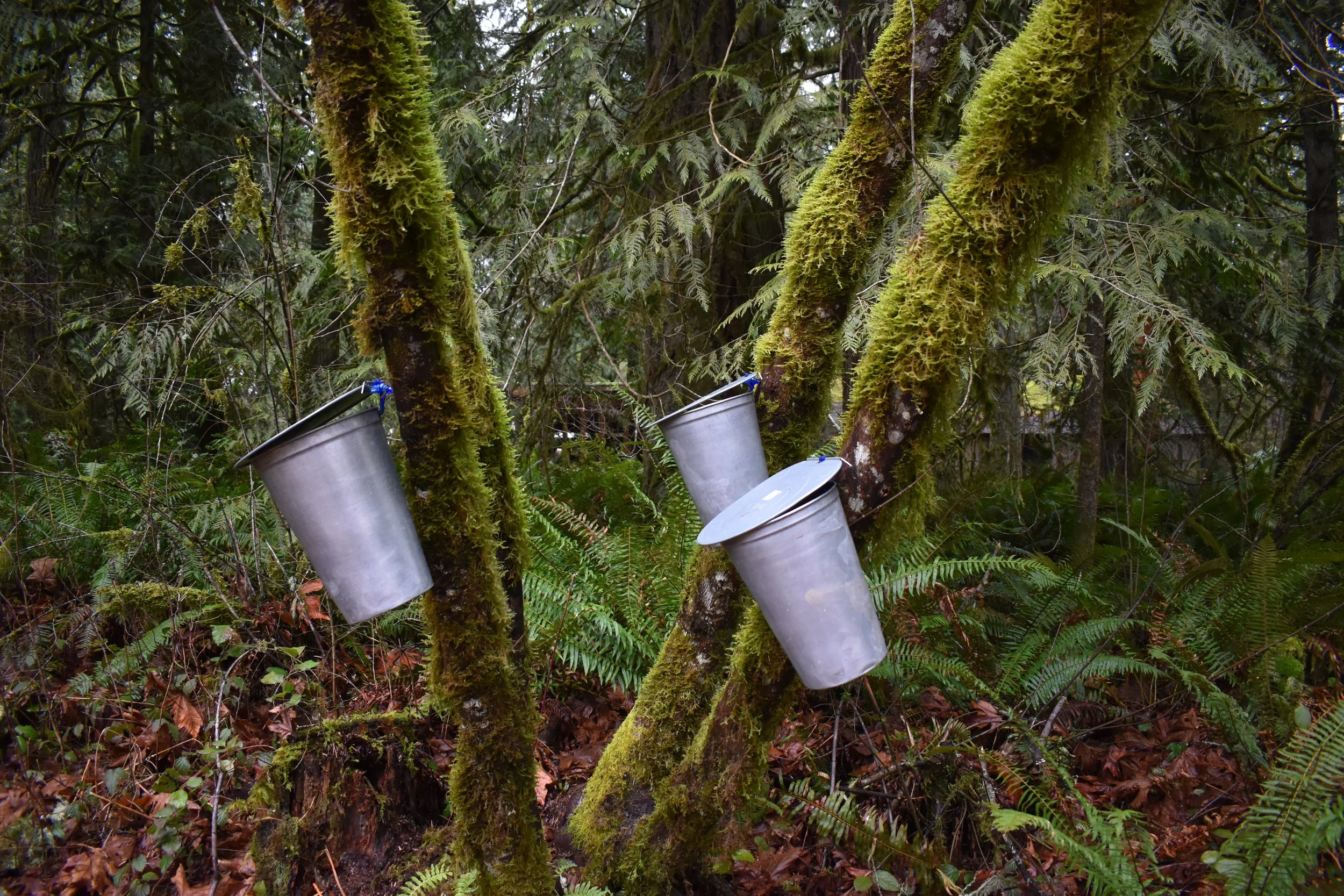
Tapping a bigleaf maple follows the same basic steps as tapping a sugar maple, with a few specific considerations (Matzka et al., 2025). Once the weather is right, drill a clean 1.5 to 2‑inch hole at a comfortable height, angling it slightly upward to help sap flow. Use a sterile 5/16‑ or 1/4‑inch bit, clear out the shavings, and gently tap in the spile so it fits snugly without splitting the wood.
While hanging pails work, the Pacific Northwest’s warmer, less predictable sap flow often makes them less reliable. Many hobbyists instead run 5/16‑inch food‑grade tubing from the spile to a sealed bucket on the ground, which helps keep sap cleaner and reduces losses during inconsistent runs.
Once collected, bigleaf maple sap must be concentrated to transform it into syrup. With RO as a recommended first step, sap is then brought to boil over a propane burner or wood-fired evaporator, slowly reducing the water until the liquid thickens and reaches the characteristic syrup temperature. Whether using boiling alone or pairing it with RO, the goal is the same: concentrate the sap’s sugars and flavors into a dark, rich syrup unique to the Pacific Northwest.
The sweet reward at the end of the process, bigleaf maple syrup, often surprises first‑time tasters. Its flavor is commonly described as rich and layered, with notes of butterscotch, caramel, toffee, vanilla, and molasses with gentle earthy or woodsy undertone.
Community, Education, and a Sweet Future
Beyond emerging technology like the use of small-scale RO systems, another reason more landowners are venturing into bigleaf maple sugaring is the growing number of examples and mentors.
In February 2026, the Oregon chapter of the Women Owning Woodlands Network toured the Oregon Maple Project’s sugaring operation. Founded by schoolteacher Eliza Nelson in 2020, the Oregon Maple Project inspires experiential learning, community partnership, and connection to nature through local syrup production. The goal of the tour was not only to teach attendees about the art and science of bigleaf maple sugaring, but also to highlight the women-led organization paving the way for future tree tappers.
As Eliza shared, “We are in the midst of a bigleaf maple movement in the Pacific Northwest, and it’s exciting to be learning together. We have the chance to build an inclusive sugaring community, with historically underrepresented groups (including women) joining in early to help shape best practices, training, and collaboration.”
As more hobbyists and producers experiment with bigleaf maple syrup, a small yet enthusiastic market is taking shape. Bottles are beginning to appear at farmers markets, local shops, and seasonal festivals – often selling out quickly due to limited supply. Chefs across the region are incorporating the syrup into specialty dishes and craft beverages, celebrating it as a distinctly Pacific Northwest ingredient. For landowners, tapping bigleaf maple offers a low‑impact, value‑added opportunity that fits naturally within broader forest management goals.
Learn More
You can learn more about the Oregon Maple Project and their mission at oregonmapleproject.org. For guidance on making bigleaf maple syrup, check out the newly revised OSU Extension publication, Bigleaf maple syrup: A hobbyist’s guide.
Sources
Bowyer, C. (2024). CLA Research: Research explores artisanal maple syrup from Pacific Northwest forests. Oregon State University School of Language, Culture, and Society.https://liberalarts.oregonstate.edu/slcs/cla-research-research-explores-artisanal-maple-syrup-pacific-northwest-forests
Jones, E. T. (2025). Where does my maple sap go? Northwest Woodlands, 41(2), Spring 2025.
Matzka, P., Cameron, S., Douville, M., Berger, C., Hopkins, T., & Jones, E.T., (2025) Making bigleaf maple syrup: A hobbyist's guide. OSU Extension Catalog EM9163. https://extension.oregonstate.edu/catalog/em-9163-making-bigleaf-maple-syruphobbyists-guide
Price, L. M., Colonna, A., & Jones, E. T. (2024). Chefs evaluate syrup from the wild bigleaf maple (Acer macrophyllum): A new artisanal food from Pacific Northwest forests. Gastronomy, 2(4), 155–168. https://doi.org/10.3390/gastronomy2040012